Uncategorised

Index of Educational Freedom in Latin America

Index of Educational Freedom in Latin America

A comparative diagnostic to drive better educational policies in the region.
In partnership with Templeton World Charity Foundation
Coordinated by Martín Krause

How free is education in Latin America?

The Libertad y Progreso Foundation presents the 2025 Educational Freedom Index, a unique tool that measures the extent to which families can choose how to educate their children and the degree of freedom citizens have to create alternative educational projects.

Download full report

  • Freedom to learn

    That is, the ability of families to choose their children's education.
  • Freedom to teach

    Reflects the capacity of private individuals and organizations to create their own educational projects.

In its 2025 edition, Chile leads the regional ranking, followed by Mexico and Peru, while Cuba and Venezuela rank at the bottom of the index.
[arrow-right]

The Problem

In Latin America, millions of families are unable to choose the education they desire for their children. Educational systems are often highly centralized, with little diversity in projects, lack of transparency, and strong state control over content, methods, financing, and the opening of new schools. This limits innovation, quality, and, above all, the freedom to learn and teach.

The Index Proposal

The Educational Freedom Index (EFI) evaluates the actual room for maneuver in:
  • School choice (state-run, private, or homeschooling)
  • Access to transparent information regarding educational performance
  • Funding that follows the families (rather than just state providers)
  • Opening private schools without excessive barriers
  • Managing teaching staff with autonomy
  • Defining methods and content without ideological impositions
The result is an indicator ranging from 0 to 1, where 1 represents maximum educational freedom.

Methodology

The EFI analyzes 20 Latin American countries and measures educational freedom based on two major dimensions:

Freedom to Learn

How free families are to decide how and where to educate their children. It includes:
  • School choice (private vs. state-run)

  • Homeschooling legal status and feasibility

  • Transparency of educational results

  • Demand-side financing (funding that follows the student)

Freedom to Teach

How easy it is for civil society to create and sustain schools with their own distinct projects. It includes:
  • Teacher autonomy (freedom in teaching practices)

  • Opening of independent schools

  • Freedom of methods and curricula

Main Results 2025

Key Findings

  • The region shows greater "Freedom to Teach" (0.48) than "Freedom to Learn" (0.33).
  • The weakest area is demand-side financing (funding geared toward family choice).
  • Teacher management is another critical point, due to the lack of school autonomy to hire, compensate, and evaluate teachers.
  • Chile stands out for the consolidated role of public-private collaboration.
  • Cuba represents the opposite extreme: a completely state-run education system with no educational freedom.
  • Countries with the highest educational freedom

    • Chile – 0,669
    • México – 0,576
    • Paraguay – 0,500
  • Countries with the lowest educational freedom

    • Cuba – 0,001
    • Venezuela – 0,239
    • Nicaragua – 0,300

Why does this index matter?

Because it allows us to:
  • Identify opportunities for improvement in each country

  • Compare educational policies across the region

  • Evaluate progress in educational freedom year over year

  • Promote models that are more diverse, transparent, and family-centered

Explore the diagnosis, country-by-country data, and recommendations to improve educational freedom in Latin America.

Download the full report

Read more …Index of Educational Freedom in Latin America

  • Hits: 69

Public Policy 2025

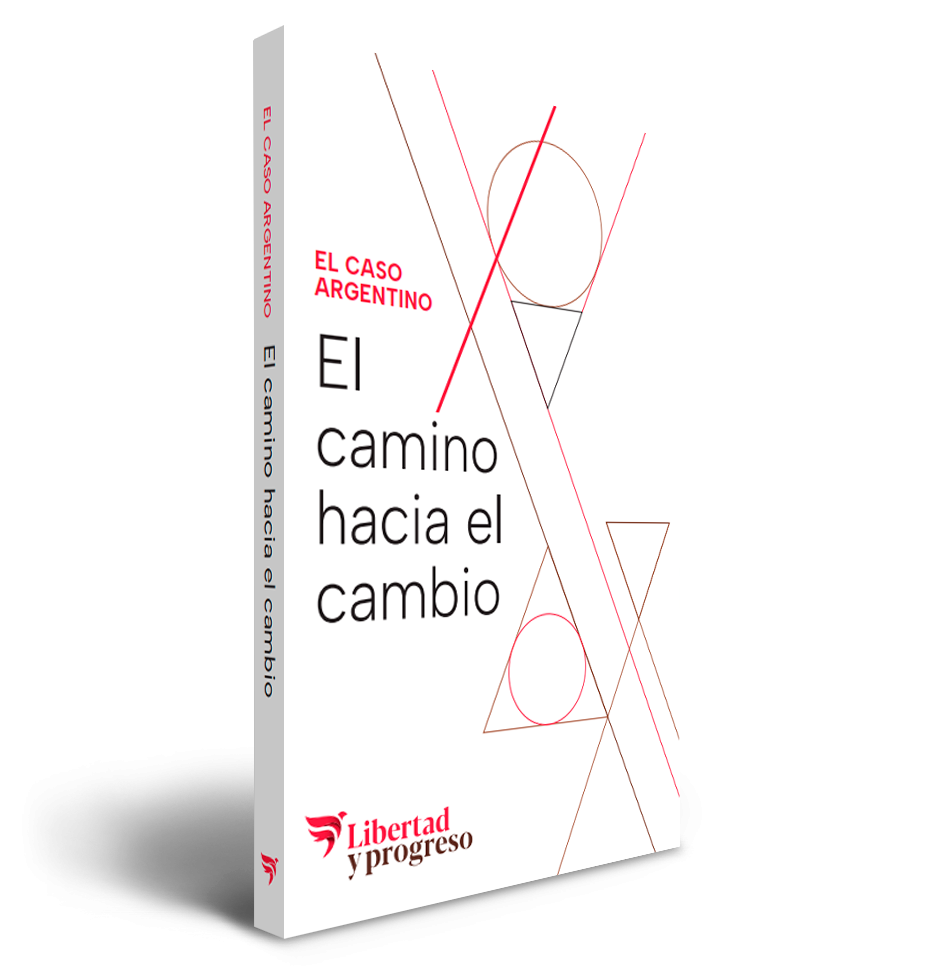
The Argentine Case

The Path Toward Change

Public Policy 2025

“Argentina has rapidly improved its position in the Index of Economic Freedom, reflecting the first positive results of the implemented reforms.”

Request our book featuring the foundation's proposed public policies.

From Stagnation and Recurring Crises to a Paradigm Shift

This is a comprehensive proposal to rethink Argentina's direction. Through a technical and programmatic approach, the book addresses the country's structural challenges and presents a roadmap for reform in key areas such as the State, labor, energy, defense, foreign policy, and more. Featuring an analysis of Javier Milei's first year in office and a look toward the future, it offers a framework for a new development paradigm.
  • 1. State Reform

    Structural reform of the state; a task still in progress.
  • 2. Deregulations in Javier Milei’s First Year

    Proposals in Economics, Health, Security, Defense, and changes to the ministerial structure.
  • 3. Labor Reform

    Milei’s labor reform, though still incomplete, aimed to simplify registration and provide legal certainty to labor relations.
  • 4. Pending Changes in Federal Tax Sharing

    Libertad y Progreso proposes that the National Government should only collect what is necessary to cover its own expenditures.
  • 5. A Defense Strategy for Argentina

    Argentina and the system of alliances.
  • 6. Foreign Policy

    Fundamental guidelines for rethinking our foreign policy.
  • 7. Trade Policy

    Fundamental criteria for defining external trade policy.
  • 8. Argentina and Climate Change

    International organizations and green financing.
  • 9. Energy Transition

    Natural gas as a bridge fuel.
  • 10. Agricultural Policy

    Removing penalties on the agricultural sector.
  • 11. Industrial Policy

    Import duties and tariff policy.
  • 12. Health Policy

    Seven proposals to streamline and improve services.

Toward Milei’s Second Year

The government's reformist drive is "one of its most positive traits," and Libertad y Progreso trusts in the will of the citizens and their representatives to deepen the reforms necessary to consolidate progress.

Foundation Research

Analysis of Emotional Profiles and Their Impact on Entrepreneurship Development

Download Research

Read more …Public Policy 2025

  • Hits: 69

Human Capital

New Area of the Foundation

Human Development

What is the new "Human Development" area of the Libertad y Progreso Foundation?

The Department of Human Development focuses on promoting public policies that enhance individual capabilities—particularly from early childhood—as the foundation for economic and social progress.
In this initial stage, the department will focus specifically on education and neuroscience, with the goal of maximizing each individual's potential and, through this, building a more prosperous society.

The department’s work is built on three pillars:

  • Education

    Promoting freedom of educational choice, innovative methodologies, and systemic reform.
  • Health and Neurodevelopment

    Specifically focusing on early childhood, seeking low-cost, high-impact interventions.
  • Labor and Skills

    While not yet fully developed, this remains a key long-term strategic axis.

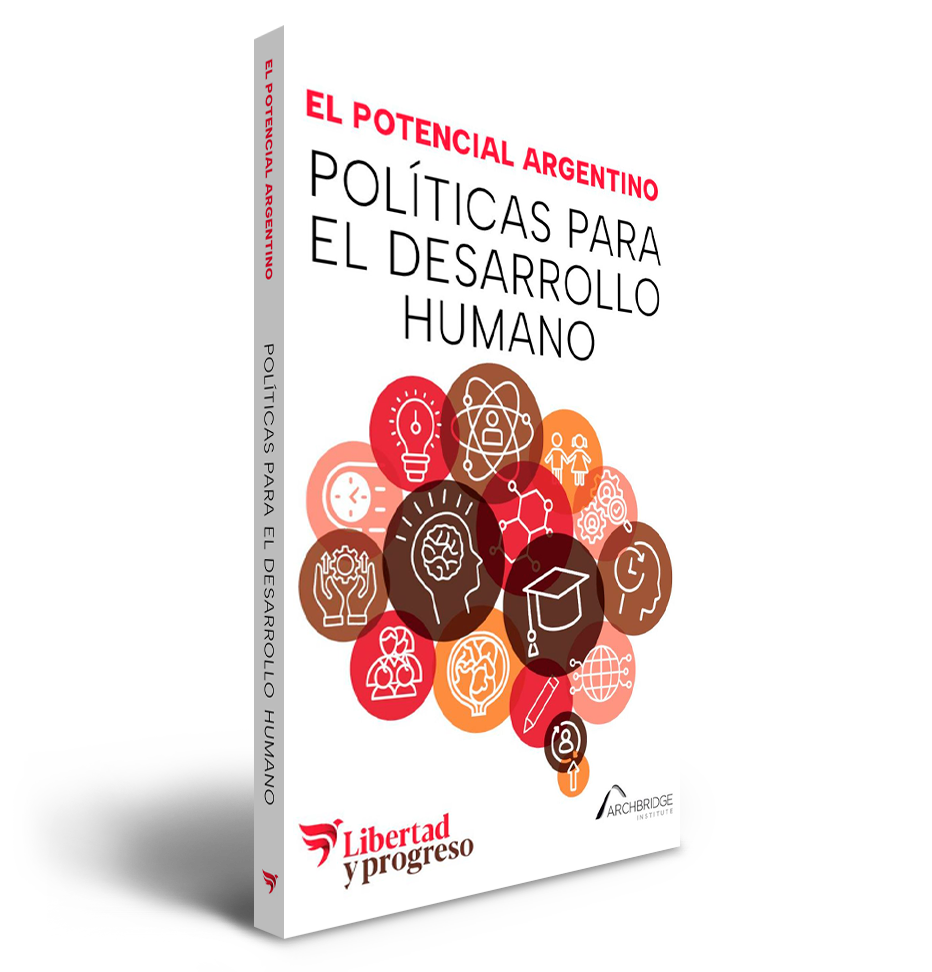
Request our book on human development policies

Request via donation

General Objectives

Our goal is to develop the full potential of every individual from childhood by promoting public policies based on liberty, scientific evidence, and the empowerment of families, teachers, and institutions to build a more prosperous society.
  • 1. Public Policy Development

    Create public policies for childhood, education, and neuro-emotional development designed to empower Argentines and maximize their potential. Collaborate with political stakeholders to drive their implementation.
  • 2. Research and Analysis of Educational Policies

    Provide evidence and arguments in favor of an approach based on freedom of choice and individual responsibility.
  • 3. Dissemination and Public Education

    Conduct information and education campaigns for the general public regarding the benefits of an educational system that promotes the freedom to choose among diverse options.
  • 4. Advocacy for Educational Choice

    Advocate for policies that allow families and students to choose the educational institutions that best align with their needs and values.
  • 5. Importing Knowledge in Neuroscience and Emotional Well-being

    Research and disseminate low-cost, high-impact interventions that have proven effective worldwide. Facilitate their local implementation.
  • 6. Empowering Parents and Teachers

    Promote reforms to grant schools greater autonomy, make teaching and curricula more flexible, and encourage the active participation of families and students in their education.
  • 7. Fostering Educational Innovation

    Promote new technologies and educational methodologies, adapting them locally and encouraging innovation through trial and error to improve education.

Programs and Projects

  • Educational Intervention Model (Pilot Project)

    Develop and evaluate a replicable educational model based on neuroscience and multiple intelligences

    Currently implemented at the San José Providente Day Center (serving 360 children). It includes comprehensive diagnostics, teacher training, family engagement, and impact metric monitoring. The intervention aims to improve cognitive, emotional, and social skills.
  • White Paper: Best Practices

    Propose evidence-based educational reforms to modernize the Argentine system.

    Based on the pilot project results and international research, a technical public policy document will be drafted. It will be published and presented to legislators and Ministers of Education for implementation.
  • Education Leaders’ Summits

    Foster collaboration among organizations, academics, and political stakeholders in education.

    Six annual meetings will be held with at least 10 organizations to share progress and coordinate efforts. Minutes will be drafted, and joint initiatives will be promoted.
  • Campaign to Repeal Article 97 of the National Education Law

    Promote educational transparency and allow the publication of results by school.

    A media and social media campaign to inform the public about the drawbacks of the current article. The goal is to generate public pressure for its amendment and present a proposal to Congress backed by allied organizations.
  • Educational Freedom Index

    Measure and compare educational freedom in Latin America.

    Directed by Martín Krause and funded by the Templeton Foundation. It collects data across several countries to create an index demonstrating how greater freedom improves outcomes. Findings are disseminated through media and meetings with opinion leaders.
  • Public Policy Book

    Systematize and disseminate the foundation's proposed policies to improve quality of life in Argentina.

    Publication of a book with chapters on human capital, health, education, etc., featuring contributions from experts such as James Heckman. It will be distributed to politicians, journalists, and academics.
  • Social Media Video Series

    Raise awareness about the need to reform the educational system.

    Six videos will be produced over two years featuring reform proposals (modernization, decentralization, teacher empowerment). These will be supported by campaigns and influencer outreach to expand their reach.
  • The Knowledge Revolution

    Explain the Human Development department's approach and impact to the general public.

    A series of three short videos aimed at young people, showcasing innovative methods and real-life cases. It seeks to inspire and generate interest in educational transformation.

Foundation Research

Analysis of Emotional Profiles and Their Impact on Entrepreneurship Development

Download Research

Read more …Human Capital

  • Hits: 83

La actividad económica volvió a crecer en febrero

SER INDUSTRIA De acuerdo al Estimador Mensual de Actividad Económica (EMAE). durante febrero la actividad registró un aumento del 5,7% interanual. Los datos fueron publicados por el Instituto Nacional de Estadística y Censos (INDEC), que consignó además que la comparación mensual mostró un crecimiento del 0,8%.

El trabajo indica que once sectores experimentaron mejoras interanuales, destacándose Intermediación financiera (30,2%) y Pesca (28,3%). Por otro lado, cuatro sectores registraron caídas, siendo los más afectados Actividades de servicios comunitarios, sociales y personales (-2,6%) y Hoteles y restaurantes (-1,4%).

La actividad de Intermediación financiera fue la que tuvo mayor impacto positivo en el crecimiento interanual del EMAE, seguida por Comercio mayorista, minorista y reparaciones, e Industria manufacturera. En contraste, las actividades de Servicios comunitarios, sociales y personales, Hoteles y restaurantes, y Administración pública y defensa fueron las de mayor incidencia negativa. Estos últimos sectores restaron 0,17 puntos porcentuales al crecimiento interanual del EMAE.

“Podría acelerar”

A poco de conocerse los datos del INDEC, Eugenio Marí, Economista Jefe de la Fundación Libertad y Progreso (LyP), consideró que “se está manteniendo un ritmo de expansión por encima del 5%”. Estimó que “tras la unificación del mercado de cambios y la eliminación de restricciones a los movimientos de capitales, incluso podría acelerar para cerrar el 2025 con una expansión del PBI más cerca del 6%“.

“Este crecimiento en términos generales se está dando de la mano de un reacomodamiento de la estructura económica, a medida que cambian los incentivos por la baja de la inflación, las reformas y las desregulaciones. Algunos sectores están bien posicionados para canalizar capitales, crecer y absorber empleo, mientras que obviamente en otros se están desnudando los problemas de competitividad”, agregó.

Marí señaló que “la clave en esta transición es acelerar la implementación de las reformas que aumenten la productividad y bajen los costos no salariales, como las privatizaciones, la reforma impositiva y la laboral. Y aquí es clave el Congreso, lo que les da más valor a las elecciones de medio término”.

Finalmente, sostuvo que “si el próximo Congreso es más amigable a cambiar las leyes que perjudican la competitividad argentina, entonces el país podrá entrar en un círculo virtuoso de reformas, reducción de la percepción de riesgo, crecimiento y baja de impuestos“.

Economía Argentina, actividad económica

  • Hits: 9
Donate